News Update — September 2026 On 11 May 2026, UK Government Minister Sarah Jones MP wrote an official letter to the Advisory Council on the Misuse of Drugs confirming the government will proceed ...
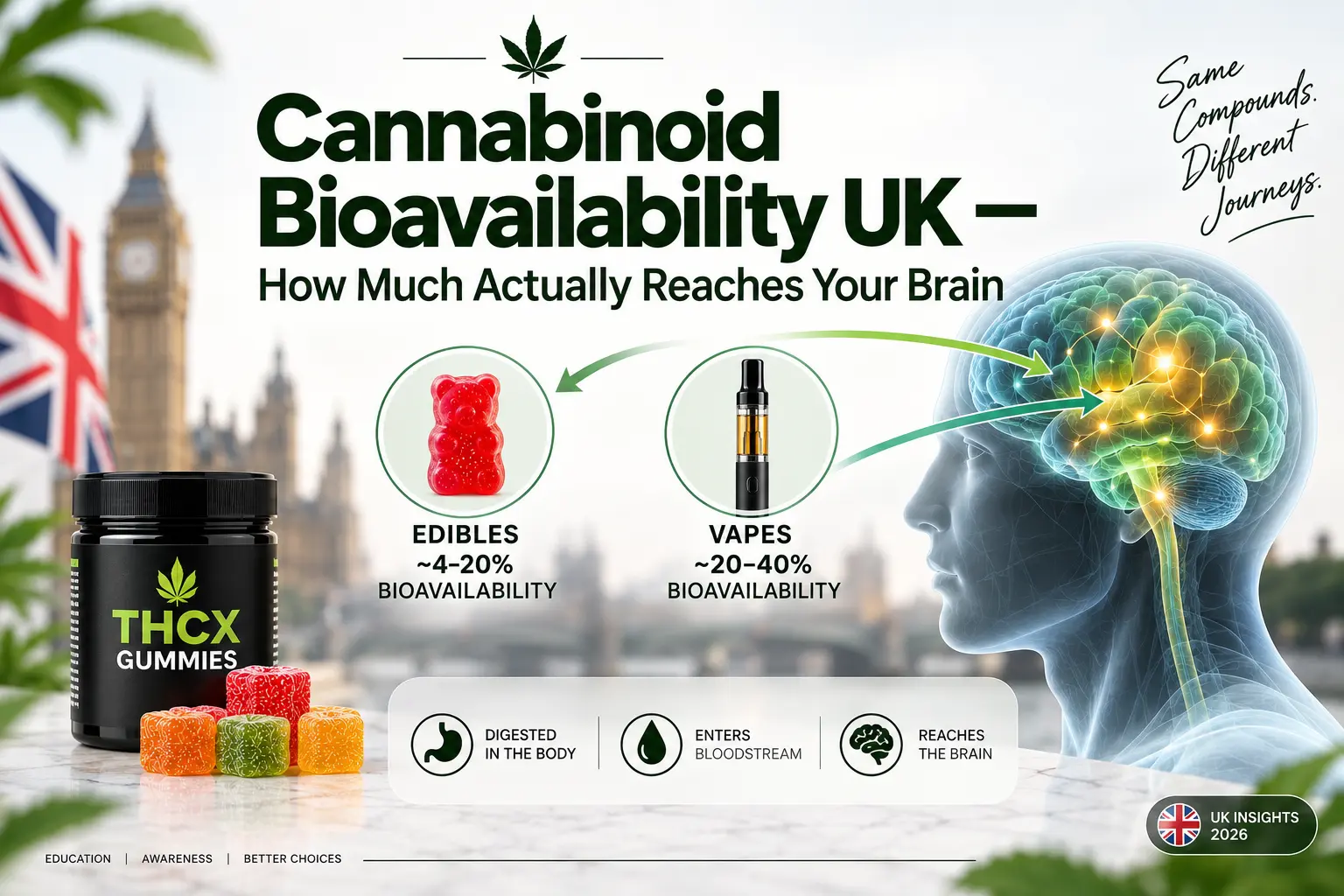
Bioavailability is the percentage of a dose that reaches systemic circulation. For cannabinoids: oral gummies 4-20%, vaping 10-35%, sublingual 12-35%. Despite lowest bioavailability, edibles produce the strongest effects because liver conversion creates more potent active metabolites. Fat consumed before a gummy session can increase oral bioavailability by up to 4x.
In This Guide:
- What is bioavailability and why does it matter
- Bioavailability by consumption method
- The bioavailability paradox — lower means stronger
- 5 factors that affect your bioavailability
- Fat and cannabinoid absorption — what the science says
- In our experience at Activist Edibles UK
- Practical guidance for UK buyers
- FAQ
Bioavailability is one of the most practically useful pieces of pharmacology for UK cannabinoid buyers to understand — because it explains why the same milligram dose produces completely different effects depending on how you consume it, what you have eaten, and your individual metabolism.
This guide covers the science in plain English, what affects your personal bioavailability, and how to apply this knowledge to get the most consistent and appropriate experience from THCX gummies, HHCP gummies, and vapes. Research published via the National Library of Medicine documents cannabinoid pharmacokinetics across administration routes in detail.
What Is Bioavailability and Why Does It Matter?
Bioavailability is the fraction of an administered dose that reaches the systemic circulation in unchanged active form and is therefore able to have an effect. A product with 100% bioavailability would mean every milligram consumed reaches the bloodstream. In practice, no oral cannabinoid product approaches this — significant amounts are lost to digestive breakdown and first-pass liver metabolism before reaching circulation.
Bioavailability directly affects how much of your paid-for cannabinoid dose actually produces effects — and it varies dramatically by consumption method, individual biology, and what you have eaten. Understanding it allows you to dose more accurately and avoid the two most common dosing mistakes: taking too much because you assumed consistent absorption, or re-dosing because you assumed the gummy was not working when it was simply still being absorbed.
Bioavailability by Consumption Method
| Method | Bioavailability | Onset | Duration | Peak Strength |
|---|---|---|---|---|
| Oral / Gummies | 4-20% | 30-90 min | 3-8 hrs | Highest (liver metabolites) |
| Inhalation / Vaping | 10-35% | 2-10 min | 1-3 hrs | Moderate |
| Sublingual / Under tongue | 12-35% | 15-45 min | 2-4 hrs | Moderate-High |
| Oral (with high-fat food) | Up to 4x increase | 45-90 min | 4-9 hrs | Highest possible |
The Bioavailability Paradox — Why Lower Means Stronger
Edibles have the lowest bioavailability but produce the strongest effects — this is the bioavailability paradox of oral cannabinoid administration. The explanation is that bioavailability measures how much of the original compound reaches circulation, but it does not account for what that compound becomes after liver conversion.
During first-pass hepatic metabolism, the liver’s CYP450 enzyme system converts cannabinoids into metabolites. These metabolites have significantly stronger CB1 receptor binding affinity than the parent compounds — meaning a lower percentage of a more potent substance outperforms a higher percentage of the original.
The practical implication for UK THCX gummy buyers: you cannot compare milligram doses between gummies and vapes as if they are equivalent. A 10mg THCX gummy dose will produce a considerably stronger experience than 10mg of THCX vaped, because the gummy route produces more potent active metabolites through hepatic conversion.
5 Factors That Affect Your Personal Bioavailability
1. Dietary fat at time of consumption
Largest single modifiable factor. High-fat food increases oral cannabinoid bioavailability by up to 4x by protecting fat-soluble cannabinoids from digestive breakdown before liver conversion. Largest impact of any lifestyle variable.
2. CYP450 enzyme activity
Genetically variable liver enzyme system that metabolises cannabinoids. Fast metabolisers: shorter duration, faster clearance. Slow metabolisers: longer effects, more accumulation with regular use. Not modifiable but explains individual variation.
3. Body fat percentage
Cannabinoids are lipophilic — they accumulate in fatty tissue and are released slowly. Higher body fat stores more cannabinoid, reducing immediate peak but extending duration. Affects drug test detection windows significantly.
4. Gut microbiome
Gut bacteria influence cannabinoid metabolism at the intestinal level before liver processing. More diverse microbiome correlates with more consistent absorption patterns. Partially modifiable through diet and lifestyle.
5. Formulation and product quality
Gummy formulation affects absorption. Products using lipid-enhanced delivery or nano-emulsification increase bioavailability compared to basic oil-in-sugar matrices. COA-verified potency confirms dose present — not dose absorbed.
Fat and Cannabinoid Absorption — What the Science Says
THCX and HHCP are highly lipophilic — they have strong affinity for fat molecules, which fundamentally changes how they are absorbed orally. On an empty stomach, most of the cannabinoid in a gummy is exposed to the aqueous digestive environment, where it is less soluble and more vulnerable to breakdown before reaching the liver.
When dietary fat is present, cannabinoids dissolve into fat globules in the intestine. These fat globules are absorbed via the lymphatic system rather than the portal vein — partially bypassing the first-pass liver metabolism that would otherwise reduce the amount reaching circulation, and increasing the total dose available for CB1 receptor binding.
Practical application: a light high-fat snack 30-60 minutes before your THCX or HHCP gummy session — not a heavy meal — produces the best bioavailability outcome. A heavy meal delays onset by 20-40 minutes without proportionally increasing the absorption benefit. Good options: half an avocado, 30g of mixed nuts, full-fat cheese on crackers, a tablespoon of peanut butter.
In Our Experience at Activist Edibles UK
At Activist Edibles UK, bioavailability variation is one of the most consistent explanations for why customers at the same tolerance level report different intensities from the same THCX gummy dose. The most common pattern is customers who take their gummies after a large evening meal reporting slower onset and slightly less intense peak than those who take them on a lighter stomach.
We recommend the same thing to every customer who asks about optimising their dose: consistency of conditions. Take your gummies at the same time of day, with the same food situation, and you will get far more predictable results session to session. The biggest source of unexpected variation in THCX gummy experiences is inconsistent food intake at the time of consumption — not product variation.
All Activist Edibles UK products are third-party lab tested per batch — the COA confirms the cannabinoid content present in the gummy. The absorbed dose will vary by individual and session conditions, but the dose you are starting from is verified and consistent.
Practical Guidance for UK Buyers
For consistent sessions
Take gummies at the same time of day with the same food conditions. This gives you the most repeatable baseline for calibrating your personal dose over time.
For maximum effect from your dose
Light high-fat snack 30-60 minutes before. Avocado, nuts, cheese. Do not eat a heavy meal — this delays onset without increasing bioavailability proportionally.
For transitioning from vapes to gummies
Start at 50% of your vape-equivalent milligram dose. The oral bioavailability is lower but liver metabolites are more potent — net effect is stronger for most users. Always wait 90 minutes before any re-dose consideration.
Never re-dose early
Slow onset does not mean poor bioavailability — it means the gummy is still being absorbed. Both doses will arrive at peak simultaneously if you re-dose at 45 minutes because “nothing is happening.”
Related Science and Product Guides
- Endocannabinoid System UK — How Cannabinoids Work
- Why Edibles Hit Harder Than Vapes — The Science
- How Long Do Edibles Take to Work UK?
- THCX Gummies Dosage UK
- Do THCX Gummies Get You High?
- Shop All Gummies UK — Activist Edibles
Frequently Asked Questions
What is cannabinoid bioavailability?
Bioavailability is the percentage of a consumed dose that reaches systemic circulation and produces effects. For cannabinoids: oral edibles 4-20%, inhalation via vaping 10-35%, sublingual 12-35%. Despite lowest oral bioavailability, edibles produce the strongest effects because liver conversion during first-pass hepatic metabolism creates more potent active metabolites that bind CB1 receptors more intensely than the original compound.
How can I increase cannabinoid bioavailability from gummies?
Eating high-fat food 30-60 minutes before taking a THCX or HHCP gummy increases oral bioavailability by up to 4x compared to fasted state. THCX and HHCP are fat-soluble and dissolve in dietary fat, protecting them from digestive breakdown before liver conversion. Avocado, cheese, nuts, peanut butter. A light snack rather than a heavy meal is optimal — heavy meals delay onset without proportionally increasing absorption.
Why do THCX gummies feel stronger than THCX vapes despite lower bioavailability?
First-pass liver metabolism converts oral THCX into metabolites that bind CB1 receptors more intensely than the original compound. Vaping bypasses the liver — cannabinoids enter unchanged via the lungs. A lower percentage of a more potent metabolite outperforms a higher percentage of the unchanged original. This bioavailability paradox explains why edibles are always stronger than vaping the same milligram dose.
Why does the same gummy dose produce different effects at different times?
Oral cannabinoid bioavailability varies significantly based on what you have eaten, your hydration level, your metabolic state, and gut microbiome activity. The biggest single variable is dietary fat intake — the presence or absence of fat at the time of consumption can change effective absorbed dose substantially. Taking gummies under consistent conditions produces far more predictable results than varying food intake session to session.
Does body fat affect how cannabinoids work?
Yes. Cannabinoids are lipophilic and accumulate in fatty tissue, where they are stored and released gradually. Higher body fat means more storage capacity — some of the absorbed dose is sequestered in fatty tissue rather than remaining active at CB1 receptors. This can reduce immediate peak intensity but significantly extends the detection window for drug tests, as metabolites continue being released and excreted from fatty tissue long after effects have ended.
Educational content only. Not medical advice. For adult use only (18+). References: National Library of Medicine — Cannabinoid Pharmacokinetics. UK law subject to change — verify at legislation.gov.uk.