
News Update — September 2026 On 11 May 2026, UK Government Minister Sarah Jones MP wrote an official letter to the Advisory Council on the Misuse of Drugs confirming the government will proceed ...
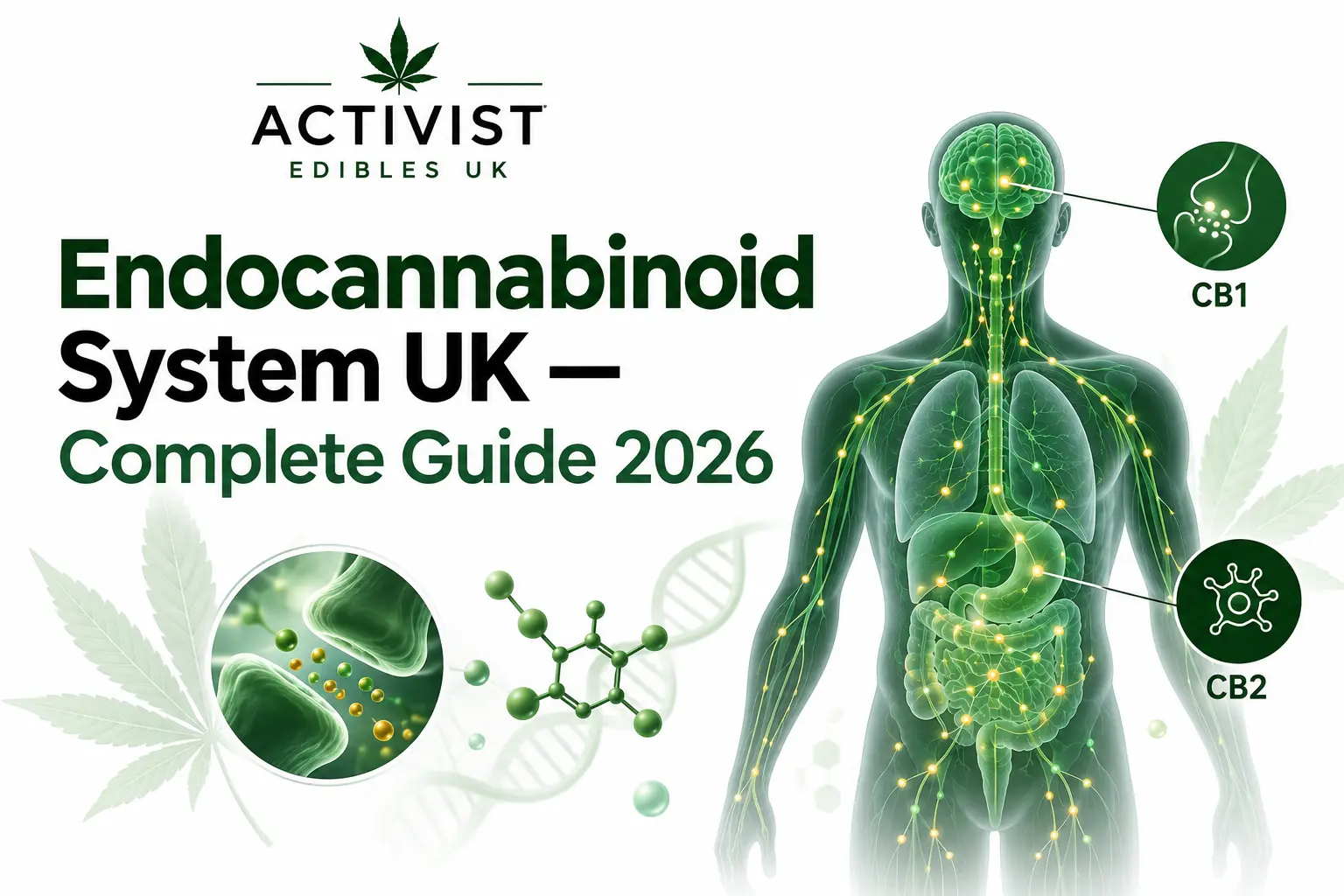
The endocannabinoid system UK (ECS) is a biological signalling network in every human body. It regulates mood, appetite, pain, sleep and memory through two main receptors — CB1 (brain and nervous system) and CB2 (immune system). Cannabinoids like THCX, HHCP and CBD work by interacting with these receptors. THCX and HHCP bind strongly to CB1 — producing strong psychoactive effects. CBD interacts indirectly — no high.
Shop cannabinoid products at Activist Edibles UK — THCX Gummies (UK Exclusive) — HHCP Gummies — CBD Gummies
In This Guide:
Understanding the endocannabinoid system is the single most useful piece of science a UK cannabinoid buyer can have. It explains why CBD does not get you high, why THCX gummies feel stronger than vaping the same amount, why tolerance develops, and why two people taking the same dose have completely different experiences.
This guide covers the system itself, how it works, what CB1 and CB2 receptors do, and how every cannabinoid in the Activist Edibles UK range interacts with it — from non-psychoactive CBD through to very potent THCX gummies.
What Is the Endocannabinoid System?
The endocannabinoid system is a cell-signalling network that maintains biological balance across nearly every system in the human body. It was first identified in the early 1990s during research into how delta-9 THC produces its effects — and the discovery fundamentally changed how scientists understand human physiology.
The ECS has three core components that work together as a system:
1. Endocannabinoids
Molecules your body produces naturally — primarily anandamide (AEA) and 2-arachidonoylglycerol (2-AG). These are the body’s own cannabis-like compounds, produced on demand to regulate system balance. Anandamide is often called the “bliss molecule” due to its role in mood regulation.
2. Receptors (CB1 + CB2)
Proteins embedded in cell membranes throughout the body that endocannabinoids and external cannabinoids bind to. CB1 receptors are concentrated in the brain and central nervous system. CB2 receptors are found primarily in the immune system and peripheral tissues.
3. Enzymes
Proteins that break down endocannabinoids after they have performed their function — primarily FAAH (breaks down anandamide) and MAGL (breaks down 2-AG). These prevent the system from becoming overactivated and maintain homeostasis.
CB1 Receptors — Why Cannabinoids Get You High
CB1 receptors are concentrated in the central nervous system — particularly the brain — and are responsible for every psychoactive effect produced by cannabinoids. CB1 is one of the most abundant G protein-coupled receptors in the human brain, found predominantly on presynaptic neurons where it modulates neurotransmitter release.
When a cannabinoid binds to CB1, it modulates the release of neurotransmitters including dopamine, GABA, and glutamate. This is what produces effects ranging from mild relaxation at low binding levels through to intense euphoria, appetite stimulation, time distortion, and heightened sensory perception at strong CB1 binding levels.
The key factor determining potency is binding affinity — how strongly a cannabinoid attaches to CB1 relative to a reference compound. Research from the National Library of Medicine has documented the comparative binding affinities of cannabinoids including THCP showing approximately 33x greater CB1 binding than standard THC — explaining its significantly stronger reported effects.
CB2 Receptors — The Immune System Connection
CB2 receptors are found primarily on immune cells — B lymphocytes, macrophages, mast cells — and regulate inflammatory processes rather than psychoactive effects. Activating CB2 does not produce a high. It modulates immune response and inflammation signalling.
CBD interacts preferentially with CB2 and modulates the system indirectly rather than binding directly to CB1 — which is the biological explanation for why CBD produces no psychoactive effects despite being a cannabinoid. This is also why CBD can legally be sold without the age restrictions that apply to THCX and HHCP products.
How THCX, HHCP, THCP and CBD Compare
| Cannabinoid | CB1 Binding | Psychoactive? | Effect Character | UK Status 2026 |
|---|---|---|---|---|
| CBD | Indirect only | No | Calm, no impairment | Legal ✅ |
| HHCP | Strong | Yes — strong | Heavy sedation, 3-8hrs | Grey area ⚠️ |
| THCX | Very strong | Yes — very strong | Euphoric, clean, 3-6hrs | Legal ✅ |
| THCP | ~33x stronger than THC | Yes — very strong | Intense, heavy, 1-3hrs (vape) | Legal ✅ |
| Delta-9 THC | Standard reference | Yes | Euphoric | Class B ❌ |
Why Cannabinoids Affect People Differently
Individual response to cannabinoids varies because CB1 receptor density, endocannabinoid baseline levels, enzyme activity, and body composition all differ between people. This is why two people taking the same THCX gummy dose have noticeably different experiences.
CB1 receptor density
People with higher CB1 receptor density in relevant brain regions typically experience stronger effects at equivalent doses. This varies genetically and changes with regular cannabinoid use — which is why tolerance develops over time.
CYP450 enzyme metabolism rate
The CYP450 enzyme system in the liver processes cannabinoids at genetically variable rates. Fast metabolisers clear cannabinoids quickly — shorter duration, faster onset. Slow metabolisers experience longer, sometimes more intense effects at the same dose.
Body fat percentage
Cannabinoids are lipophilic — they dissolve in and accumulate in fatty tissue, released slowly over time. Higher body fat means more storage capacity, affecting both the duration of effects and how long metabolites are detectable in drug tests after use.
Baseline ECS tone
People with naturally lower endocannabinoid system activity often report more pronounced effects from the same cannabinoid dose. This baseline varies significantly and is not something observable or testable outside a clinical setting.
Tolerance — The Biology Behind It
Tolerance to cannabinoids develops through CB1 receptor downregulation — the body reduces receptor density in response to repeated strong stimulation. With fewer CB1 receptors available to bind, the same dose produces weaker effects over time.
This is why experienced regular users need higher doses than first-timers to achieve the same effect. It is also why tolerance breaks work — a period without cannabinoid use allows CB1 receptor density to recover, resetting sensitivity.
For UK THCX gummy users, the practical implication is clear: if effects feel weaker over several sessions at the same dose, a 1-2 week break from psychoactive cannabinoids will restore sensitivity more effectively than increasing the dose.
In Our Experience at Activist Edibles UK
At Activist Edibles UK, the most common pattern we see among customers who try THCX gummies for the first time is underestimating the onset time and re-dosing early — because they expect the experience to feel the same as vaping. It does not. The liver conversion process means a THCX gummy session is a fundamentally different pharmacological experience to vaping the same cannabinoid.
UK buyers who come to us from CBD backgrounds are often surprised by how pronounced THCX effects are. The ECS explanation above is why: CBD barely activates CB1 directly — THCX binds it very strongly. The difference is not just potency, it is a qualitatively different type of interaction with the same receptor system.
The most consistent feedback we receive about THCX gummies specifically is the cleanliness of the euphoria compared to HHCP — which maps directly to the ECS science. THCX produces strong CB1 activation with a more euphoric, functional character. HHCP produces comparable CB1 activation with a heavier, more sedating profile. Same receptor system, different effect character because of different molecular binding profiles.
Which Product Based on ECS Science
| If you want | ECS Mechanism | Product |
|---|---|---|
| No high — calm only | Indirect CB1/CB2 modulation | CBD Gummies |
| Strong euphoria — clean | Strong CB1 binding — euphoric profile | THCX Gummies (UK Exclusive) |
| Heavy body sedation | Strong CB1 binding — sedating profile | HHCP Gummies |
| Fast onset — controllable | Pulmonary absorption — bypasses liver | THCP or HHCP Vapes |
Related Guides
- UK Cannabinoid Law 2026 — Complete Legal Status Guide
- How Long Do Edibles Take to Work UK?
- THCX UK — Complete Guide 2026
- Do THCX Gummies Get You High?
Frequently Asked Questions
What is the endocannabinoid system?
The endocannabinoid system is a cell-signalling network in the human body that regulates mood, appetite, pain, sleep and memory. It consists of endocannabinoids produced naturally by the body, receptors (CB1 and CB2), and enzymes that break them down. External cannabinoids like THCX, HHCP, and CBD work by interacting with this same system.
What is the difference between CB1 and CB2 receptors?
CB1 receptors are concentrated in the brain and central nervous system — binding to them produces psychoactive effects including euphoria, appetite stimulation, and time distortion. CB2 receptors are found primarily in the immune system and regulate inflammation without producing a high. THCX and HHCP bind strongly to CB1. CBD interacts with CB2 and modulates CB1 only indirectly.
Why do cannabinoids affect people differently?
Individual response varies due to differences in CB1 receptor density, CYP450 metabolism rate, body fat percentage, tolerance level, and baseline endocannabinoid system tone. This is why two people taking the same THCX gummy dose at Activist Edibles UK can have noticeably different experiences — the underlying biology differs even at identical doses.
Why does CBD not get you high if it is a cannabinoid?
CBD does not bind directly to CB1 receptors — it interacts with the endocannabinoid system indirectly, primarily through CB2 and enzyme modulation. Without direct CB1 activation, no psychoactive effect is produced. This is why CBD produces calm without impairment while THCX and HHCP produce strong psychoactive effects — both are cannabinoids, but they interact with the ECS in fundamentally different ways.
What causes cannabinoid tolerance and how do you reset it?
Cannabinoid tolerance develops through CB1 receptor downregulation — the body reduces receptor density in response to repeated strong stimulation, meaning the same dose produces weaker effects over time. A 1-2 week break from psychoactive cannabinoids allows CB1 receptor density to recover, resetting sensitivity. This is more effective than increasing dose, which accelerates further tolerance development.
Where can I buy THCX gummies in the UK?
Activist Edibles UK at activistediblesuk.co.uk is the only verified UK retailer stocking THCX gummies. Available in four flavours: Apple Rings, Fruit Mix, Happy Peaches, and Sour Cola. All third-party lab tested, 0% delta-9 THC, standard card payment, plain unbranded packaging, full UK tracking, 2-4 day delivery, no minimum order.
Educational content only. Not medical advice. For adult use only (18+). All Activist Edibles UK products are 0% delta-9 THC and third-party lab tested. UK cannabinoid law is subject to change — verify at legislation.gov.uk before purchasing.